
The property tax is calculated based on the rental value of your property. The attic, often seen as just a storage space under the roof, raises a specific tax question: does it factor into this calculation, and if so, from what point? The answer depends entirely on its condition, use, and the declarations made to the administration.
Raw attic or converted loft: compared tax impact
The tax treatment of an attic varies depending on whether it remains in its original state or has undergone renovation. Here are the main differences.
You may also like : Everything You Need to Know About the Westie: Temperament, Breeding Tips, and Tricks for Your Companion
| Criterion | Unfinished attic | Converted loft |
|---|---|---|
| Ceiling height | Less than 1.80 m | Equal to or greater than 1.80 m |
| Considered in the living area | No | Yes |
| Effect on rental value | None or marginal | Direct increase |
| Mandatory declaration | No (unless change of use) | Yes, within 90 days of completion |
| Development tax | Not applicable | Applicable if new floor area is created |
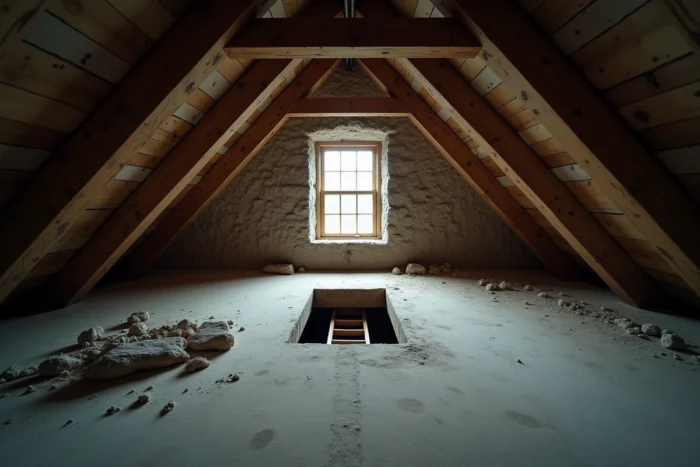
A raw attic, with exposed beams and insufficient height, does not change the tax base. It is not counted as a living space by the tax administration.
When you undertake work to transform this space into a bedroom, office, or laundry room, the situation changes radically. The created area adds to the rental value, which mechanically increases the property tax. The question of whether an attic is included in taxes falls under a declaration obligation or an administrative automaticity finds its answer here: it is the owner’s declaration that triggers the recalculation.
Read also : How much alcohol do you need to consume to reach 2 grams in the blood?
Declaration of work and 90-day deadline: a frequently ignored obligation
After the completion of loft conversion work, the owner has a 90-day deadline to declare the changes to the property tax center. This declaration is made via form H1 (individual house) or H2 (condominium apartment).
The administration uses the declared elements to recalculate the rental value. The new living area, insulation, created openings, and accessibility of the room are included in the evaluation.
Failure to declare exposes one to reassessment. Tax services regularly cross-check data with building permits issued by the town hall. If a building permit or prior declaration has been filed for converting the loft, the absence of a corresponding tax declaration will eventually come to light.
Development tax: a separate additional cost
The development tax is distinct from the property tax. It is due only once, at the time of creating new floor area. In 2026, the flat rate is 892 euros per m² outside Île-de-France and 1,011 euros per m² in Île-de-France. This value serves as the basis for the calculation, to which the rates voted by the municipality and the department are then applied.
For an attic converted into a living space, this tax can represent a significant amount, especially in municipalities where local rates are high.
Temporary exemption from property tax after loft conversion
A point rarely highlighted by owners: converting an attic can entitle one to a temporary exemption from property tax for two years. This exemption applies when the work constitutes new construction, reconstruction, or an addition to construction.
The condition to benefit from this is precisely what traps many owners: the completion of the work must be declared within the 90-day deadline. Without this declaration, the right to exemption is lost, and the increase in property tax applies retroactively without compensation.
- The exemption covers the two full years following the completion of the work, starting from January 1 of the year after.
- Some municipalities may vote to eliminate their share of the exemption, which reduces the tax benefit to only the departmental share.
- The declaration form must specify the exact nature of the work for the administration to qualify the operation.
Annual revaluation of rental values: a cumulative effect
Beyond the one-time declaration, property tax evolves each year based on a revaluation coefficient for rental values. For 2026, this coefficient is estimated at approximately +0.8% according to analyses of the finance bill.
This increase applies to all properties, whether converted or not. However, for a property whose area has increased after loft conversion, the effect is double: the base has been raised by the new area, then it is annually revalued by this coefficient.

Attic, cellar, laundry room: which spaces really impact property tax
The attic is not the only space whose tax treatment can be confusing. The cellar, garage, and laundry room follow a similar logic but with nuances.
- An unfinished cellar is considered an outbuilding and is included in the calculation of rental value with a low weighting, much lower than that of a living room.
- A closed garage is counted as a built outbuilding. Its area is weighted differently than a main room.
- A laundry room converted in a basement or attic follows the same regime as a living room if it meets height and accessibility criteria.
- Lost attics, with a slope of less than 30 degrees and insufficient height under the beams, remain outside the calculation of living area.
The tax administration does not reason in terms of room names (attic, cellar, laundry room) but in terms of physical characteristics: height, accessibility, insulation, actual use. A space labeled “attic” on a plan but converted into a bedroom with a skylight and heating will be treated as a living room.
An unfinished attic does not impact your property tax. As soon as it becomes a living space, the declaration within 90 days determines both the amount of the increase and access to the temporary exemption. Neglecting this formality means paying more, for longer.