
A high-performance beauty routine is not measured by the number of bottles lined up on the shelf. It is judged by skin tolerance, the consistency of application, and the suitability of the chosen active ingredients to the actual time available each morning. We have observed a clear shift towards streamlined protocols in recent seasons, where each product serves a specific function without redundancy or the risk of irritating interactions.
Skin tolerance and cosmetic overload: the true criterion of a beauty routine
Layering serum, essence, ampoule, cream, and oil on the same face, morning and night, multiplies the potential sources of friction between actives. Reducing the number of products decreases the risk of irritation. A gentle cleanser, a moisturizer suitable for the skin type, and sun protection cover the majority of daily needs.
Recommended read : Everything You Need to Know About the Westie: Temperament, Breeding Tips, and Tricks for Your Companion
Skinimalism, which favors short and gradually adjusted routines, is based on this principle. Adding an active ingredient (retinol, glycolic acid, vitamin C) is only done after stabilizing the base. We recommend introducing only one new active at a time, over a period of two to three weeks, to isolate any reaction.
When you browse the beauty tips from La Mode Urbaine, you will find this approach: focusing on the quality of a few gestures rather than the quantity of accumulated products.
Read also : Mini appetizer burgers to prepare the day before: tips and easy recipe to delight your guests
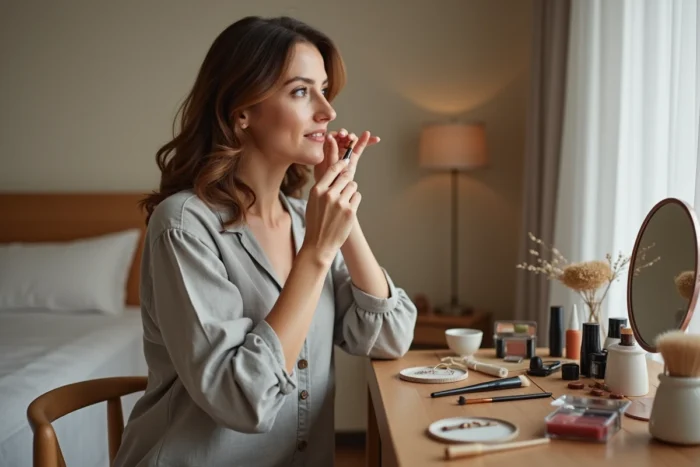
Order of application for facial care: texture and penetration
The order of application determines the effectiveness of the actives. The basic rule remains the progression of texture, from the most fluid to the most occlusive. A watery serum penetrates better when applied to clean, slightly damp skin, before any cream or oil.
Morning sequence for combination to oily skin
- Cleaning with a gentle sulfate-free gel that preserves the hydrolipidic film without stripping the dry perioral areas
- Serum based on niacinamide or hyaluronic acid, applied on damp skin to maximize hydration
- Lightweight, non-comedogenic moisturizer that also serves as a base under sun protection
- Minimum SPF 30 sunscreen, even indoors if you work near a window (UVA rays penetrate glass)
Evening sequence: cleansing takes precedence over the rest
Double cleansing (oil then gel) remains relevant on days of heavy makeup or thick sunscreen. On makeup-free evenings, a single pass is sufficient. Excessive cleansing weakens the skin barrier just as much as insufficient cleansing.
Applying a richer night cream is justified by the nocturnal cell renewal cycle. The night cream or vegetable oil then acts as an occlusive that limits transepidermal water loss during sleep.
Daily sun protection: beyond the beach
Sunscreen is not a seasonal treatment. UVA rays, responsible for skin aging, maintain a relatively constant intensity throughout the year and penetrate clouds as well as windows. When working from home, if your desk is facing a window, daily SPF remains relevant even without going outside.
The choice of filter (mineral or organic) depends on skin type. Mineral filters (zinc oxide, titanium dioxide) are better suited for reactive skin. Organic filters offer lighter textures, often preferred under makeup. In both cases, the amount applied is as important as the SPF: about half a teaspoon for the face.

Adapting your routine to available time: the overlooked factor
A seven-step protocol that you abandon after ten days is less valuable than a three-step routine maintained over several months. Consistency outweighs complexity. We observe that most skin responds well to a simple protocol maintained over time, rather than an accumulation of sporadic treatments.
If you only have five minutes in the morning, focus on cleansing and sun protection. The serum can be reserved for the evening when the pace is less constrained. Adjusting the routine to your actual schedule, rather than aiming for a theoretical ideal, improves adherence and thus the visible results on the skin.
What really changes the complexion in the long term
Sleep, internal hydration, and diet play a role that cosmetics alone cannot compensate for. Dehydrated skin from the inside will not be saved by the best cream on the market. Drinking enough water, sleeping regularly, and limiting high glycemic index foods contribute to a more even complexion.
On the external care side, gentle exfoliation once or twice a week is sufficient to revive radiance without aggression. Coarse mechanical scrubs should be avoided on sensitive skin: prefer an enzymatic exfoliant or a low-concentration lactic acid.
The best beauty routine is one that fits into your daily life without friction. Three well-chosen products, applied in the correct order and consistently, will always yield better results than a dozen treatments used intermittently. The first step to take is not to buy a new serum, but to check that your cleanser is not stripping and that your sunscreen is actually applied every morning.