The conversion of centiliters to grams relies on a parameter that most tables oversimplify: the density of each ingredient. Applying the rule “1 cl = 10 g” to everything that goes through a measuring cup introduces weighing discrepancies that compromise the balance of a recipe, especially in light cooking where every gram of fat or sugar counts.
Density and cl-grams conversion: what the simplified rule hides
The relationship 1 cl = 10 g only holds for pure water at room temperature. This equivalence arises from a density of 1.0 g/ml. As soon as we deviate from this, the calculation changes radically.
The basic formula is: grams = centiliters × density × 10. For olive oil, which has a density around 0.92, 1 cl weighs about 9.2 g. For honey, which is significantly denser, the same centiliter exceeds 10 g by a large margin.
We recommend never converting a volume to mass without identifying the category of ingredient: aqueous liquid, fatty substance, powder, or viscous product. Knowing how many grams in 1 cl requires reasoning by ingredient family, not by universal rule.
In light cooking, the difference between 9.2 g and 10 g of oil per centiliter seems negligible. Multiply by 15 cl in a vinaigrette, and you get a difference of more than a tablespoon of fat.
Conversion table cl to grams for common ingredients
The values below are based on practical densities used in cooking. They pertain to ingredients at room temperature, not heated.
| Ingredient | 1 cl (in grams) | 10 cl (in grams) | 25 cl (in grams) |
|---|---|---|---|
| Water | 10 g | 100 g | 250 g |
| Whole milk | ≈ 10.3 g | ≈ 103 g | ≈ 258 g |
| Oil (olive, sunflower) | ≈ 9.2 g | ≈ 92 g | ≈ 230 g |
| Liquid cream | ≈ 10 g | ≈ 100 g | ≈ 250 g |
| Flour | ≈ 5.5 to 6 g | ≈ 55 to 60 g | ≈ 138 to 150 g |
| Powdered sugar | ≈ 8.5 g | ≈ 85 g | ≈ 213 g |
| Honey | ≈ 14 g | ≈ 140 g | ≈ 350 g |
| Melting butter | ≈ 9.5 g | ≈ 95 g | ≈ 238 g |
Honey and flour illustrate the two extremes. One centiliter of honey weighs more than double that of one centiliter of flour. Using the same conversion factor for these two ingredients would completely distort the caloric balance of a recipe.
Flour and powders: why volume is a trap in light cooking
Flour is the most unstable ingredient in volumetric conversion. Its apparent density varies greatly depending on whether it is packed, aerated, or sifted. Packed flour in a measuring cup can weigh up to 30% more than flour simply poured.
In practice, when a recipe states “15 cl of flour,” the actual mass ranges between 82 g and over 100 g depending on the method of filling the container. For a diet where carbohydrate intake is controlled, this discrepancy is not trivial.
- Pour the flour with a spoon into the graduated container, without packing, then level off with the back of a knife. This method yields the most reproducible results.
- Never dip the measuring cup directly into the flour package: compression increases the apparent density and distorts the measurement.
- Sift before measuring if the recipe calls for it, as sifting reduces the apparent density of the flour.
- Prefer the scale for any quantity over 5 cl of powder. Volume remains acceptable for small doses (a tablespoon, for example).
These precautions also apply to cocoa powder, icing sugar, and starch, whose fine granulation accentuates packing variations.
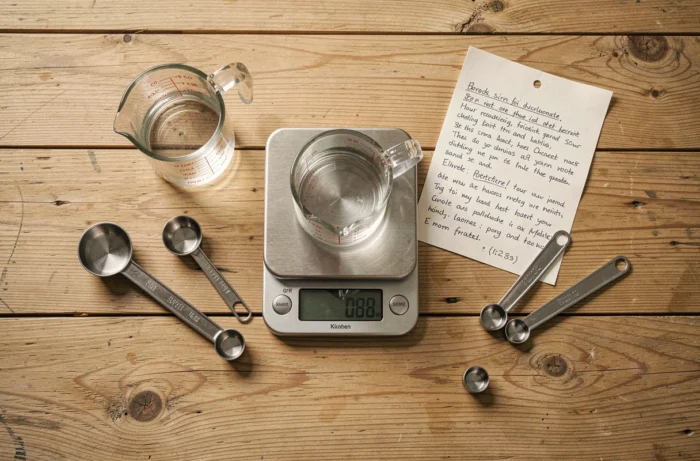
Measuring without a scale: reliable references in centiliters
In the absence of a scale, standard kitchen utensils provide usable volumetric references, provided you know their actual capacity.
- A level tablespoon contains about 1.5 cl (or 15 ml). For water, this corresponds to 15 g. For oil, about 13.8 g.
- A level teaspoon contains about 0.5 cl (5 ml). For powdered spices, count about 3 g.
- A standard glass (like a mustard glass) generally contains 20 cl, or 200 g of water.
- An empty yogurt pot corresponds to about 12.5 cl.
These references are only reliable for liquids close to water. For fatty substances and powders, systematically apply the density coefficient from the table above.

Convert cl to grams to adjust light recipes
In light cooking, substituting ingredients changes the density of the mixture. Replacing melted butter with applesauce, for example, changes the mass for the same volume. Each substitution requires recalculating the cl-grams conversion with the density of the new ingredient.
The reflex to adopt: note the approximate density of the replacement ingredient, then apply the formula grams = cl × density × 10. For applesauce, which has a density close to that of water, 10 cl will yield approximately 100 g. For agave syrup, which is denser, the same volume will weigh more.
Recipes that express quantities in centiliters rather than grams introduce a structural margin of error as soon as we move away from aqueous liquids. For precise nutritional tracking, systematically converting to grams remains the only reliable approach.
The measuring cup and graduated spoon are makeshift tools. When the goal is to control caloric intake or the texture of a preparation, a kitchen scale, even a basic one, eliminates the uncertainty related to variations in density and packing.