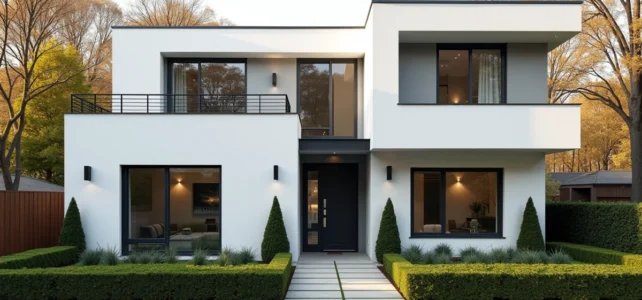
On a a renovation site, we often see the same scenario: the pure white applied as the main coating looks stunning on the day of delivery, then turns a dull gray after two winters. The anthracite gray of the frames absorbs heat and puts stress on the joints. The white and anthracite gray duo on the facade works, but only if the right shades, supports, and placements for each color are chosen.
Off-white instead of pure white: the choice that changes everything on an anthracite facade
Pure white (RAL 9010) draws attention to the slightest dirt. Gutter streaks, runoff marks, micro-algae: everything is visible. On a north or northwest-facing facade, the result becomes unmanageable within a few months without regular cleaning.
You may also like : Discover the best beauty tips to enhance your daily routine
Since 2025, there has been a marked decline in raw white in favor of off-whites like ivory, cream, or eggshell. This trend stems from a practical observation: a warm white better conceals dirt and ages more uniformly than a cool white. The contrast with anthracite gray remains sharp, but the overall appearance is less clinical, more lived-in.
When working on a white and anthracite gray house facade, the choice of white shade determines the visual durability of the project over several years. A matte vanilla white on a troweled finish, combined with RAL 7016 anthracite on the protruding volumes, yields a result that lasts over time without frequent intervention.
Further reading : How to Withdraw Your Child from School: Steps, Consequences, and Practical Tips
Distribution of anthracite gray on volumes: where to place what
The most common mistake is treating anthracite gray as a mere color accent. It is applied to shutters, the garage door, and that’s it. The result lacks coherence because the anthracite is scattered in small touches without any connection between them.
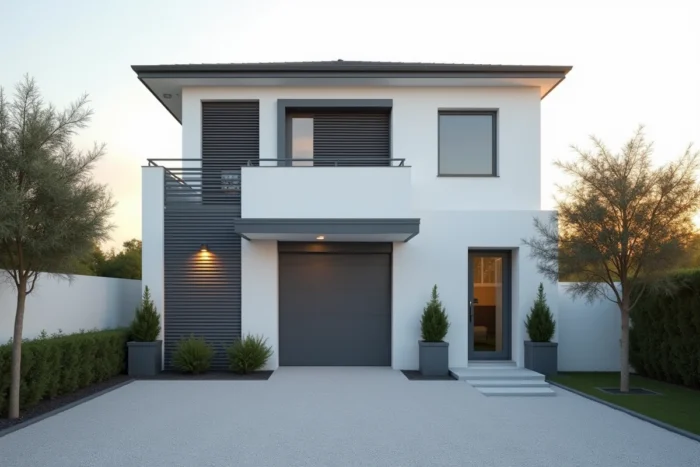
The anthracite gray benefits from covering an entire volume rather than isolated elements. On a two-story house, the entire garage projection or the entrance volume can be treated in anthracite, from the base to the underside of the roof. This approach creates a visual block that structures the facade.
Joinery and frames in anthracite: points of caution
Windows in anthracite (aluminum or mass-tinted PVC) absorb more heat than light-colored joinery. For south-facing bay windows, the returns vary on this point, but some manufacturers recommend reinforced profiles to limit expansion.
- Window frames can be treated in anthracite coating to extend the color of the joinery onto the wall, unifying the look
- Downspouts and fascia boards benefit from using the same anthracite shade to avoid the “patchwork of gray” effect
- The anthracite base (on the first 40 to 60 centimeters) visually protects against splashes of dirt and rain, while anchoring the house to the ground
Facade materials and finishes: coating, cladding, or mix
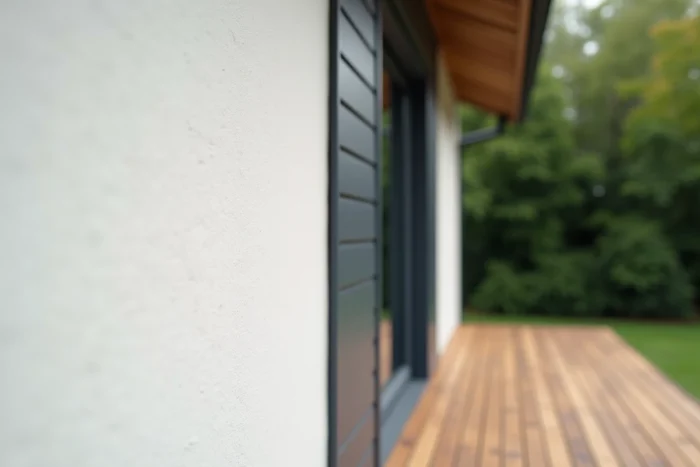
Off-white and anthracite gray do not render the same way depending on the support. A scraped finish in cream white gives a mineral and matte appearance. A wood cladding painted in anthracite adds texture and visible grain. Mixing materials enhances the contrast much more than color alone.
White troweled finish and anthracite composite cladding
This is the most common combination in recent constructions. The coating covers flat surfaces, while the cladding dresses a protruding volume (garage, extension, partial floor). Composite cladding is more UV-resistant than painted natural wood, preserving the depth of anthracite gray longer.
On existing houses made of stone or plastered concrete blocks, adding anthracite cladding to just one wall can be enough to modernize the whole without a complete renovation. The most visible wall from the street is targeted.
Natural stone and anthracite: an underutilized match
Houses with a visible stone base (gravel, granite, limestone) benefit significantly from anthracite gray on joinery and metal elements. The stone brings warmth, while anthracite adds sharpness. The off-white on the coating above the base links the two.
Urban planning constraints and aging: anticipate before painting
Your municipality’s Local Urban Plan (PLU) may restrict the colors allowed on facades. Some PLUs prohibit anthracite gray on the main surface but allow it on joinery and added elements. Consulting the PLU before finalizing the palette avoids costly disputes.
A prior declaration of works is mandatory as soon as the exterior appearance of a building is modified. Even a simple color change of coating falls under this framework.
- Check the available municipal or inter-municipal palette at the town hall or on the municipality’s website
- Request a color chart from the Architect of the Buildings of France if the house is located in a protected area
- Test the color on a sample of at least one square meter, exposed to natural light for several days before validation
Regarding aging, anthracite gray tends to powder (whitish deposit on the surface) on medium-quality coatings after a few years of exposure. This phenomenon is limited by choosing a paint or coating based on siloxane resin, which offers better resistance to UV and humidity.
Off-white, on the other hand, yellows less than pure white because the starting shade already incorporates a warm component. The color difference between the day of installation and five years later remains subtle, whereas pure white quickly shows its age.
Choosing the right materials, positioning anthracite on coherent volumes, and opting for a warm white rather than a cool one: these three decisions made in advance determine the long-term result. The rest is execution.