
An innovative French entrepreneur is not necessarily a unicorn founder who has gone through a Parisian incubator. The majority of projects that transform a market arise in much more modest contexts: a regional small business, a craft workshop, a reimagined franchise. What distinguishes these paths is less the size of the funding than the ability to solve a concrete problem with limited means.
Entrepreneurship without fundraising: the French bootstrapping model
The term bootstrapping refers to financing a company’s growth solely through its revenues, without resorting to venture capital. In France, this approach remains largely predominant among entrepreneurs, even if the media focuses attention on multi-million funding rounds.
See also : Discover how to establish the ranking of the most searched Google keywords
Several founders build profitable businesses from the first year by relying on a local network, specialized technical know-how, or a niche positioning. Their strength lies in tight cost management and a direct relationship with the end customer.
Platforms like Nos Entrepreneurs highlight these profiles often absent from tech rankings, but whose local economic impact is measurable: job creation, maintaining a commercial fabric in rural or suburban areas, skill transmission.
Read also : Discover the best beauty tips to enhance your daily routine
Bootstrapping imposes constraints that become assets. Without pressure from investors, the founder retains control over the pace of development and can test a product on a limited scope before expanding it. The absence of fundraising is not a handicap; it is a strategic choice that protects margins and decision-making freedom.
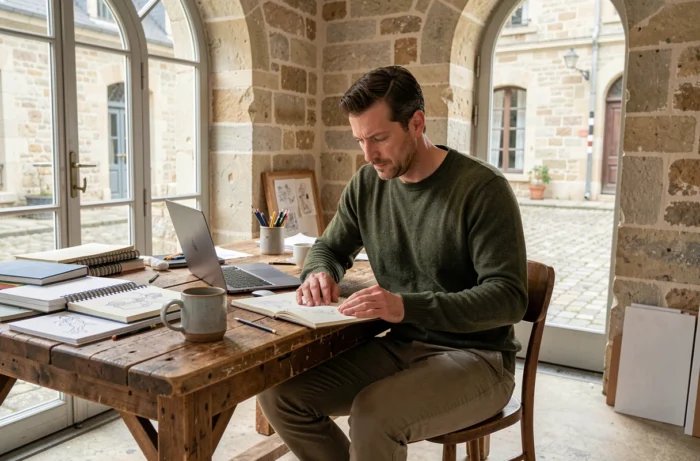
Entrepreneurial innovation outside the cities: on-the-ground portraits
French innovation is increasingly being told outside the major cities. Entrepreneurs based in Sarthe, Normandy, or the South-West are developing high value-added projects without having set foot in a Parisian coworking space.
Territorial anchoring and proximity logic
These founders share a common trait: they start from a resource or need specific to their territory. A farmer transforming his production through short circuits, an artisan reviving a local textile know-how, an engineer designing a tool adapted to the constraints of a regional sector.
Territorial anchoring becomes a competitive advantage when it allows for reducing the logistics chain, retaining a local clientele, and benefiting from often underutilized regional support mechanisms.
Innovating without central technology
Innovation does not always involve an application or an algorithm. Some French entrepreneurs rethink an existing business model:
- Adapting a franchise format to a sector that did not have one, by structuring training and logistics for independents
- Creating an alternative distribution circuit by grouping several local producers under a common brand
- Transforming an industrial waste into raw material for another sector, without technological patents but with process engineering
These approaches fall under organizational or commercial innovation, sometimes more difficult to finance than pure R&D, but just as crucial for the growth of a territory.
Founders’ working methods: what has changed recently
Portraits of entrepreneurs tend to focus on personal narratives, vocation, or the spark. The daily reality of an active founder resembles more a series of operational decisions under cash flow constraints.
A notable change concerns the adoption of generative AI in small and medium-sized enterprises. Founders are now using these tools for very concrete tasks: analyzing a customer file, drafting a commercial offer, structuring competitive intelligence, or prototyping a service idea. Generative AI reduces the entry cost into skills that were previously outsourced.
This adoption remains pragmatic. The founder does not invest in heavy technical infrastructure. They integrate a tool into an existing workflow, often starting from a modest monthly subscription. The gain is measured in hours freed up for business development or customer relations.

Female entrepreneurship in France: still under-documented journeys
Women represent an increasing share of business creators in France. Several sectors where they are in the majority (natural cosmetics, food, circular economy, social impact) are among the most dynamic in terms of value creation.
Founders like those of Rouge Français or Petits Prodïges illustrate a recurring model: starting from an unmet personal need to build a brand. The product emerges from real use, not from an abstract market study. This authenticity of the product’s genesis facilitates the engagement of a community of early customers.
Organizations dedicated to female entrepreneurship have multiplied in recent years, with mentoring networks, specific funds, and support programs. The momentum exists, but media visibility remains uneven: portraits of female founders occupy even less space than those of their male counterparts in general economic press.
Editorial formats for telling entrepreneurs’ stories: from classic portrait to operational narrative
The entrepreneur’s portrait has long followed a fixed pattern: educational background, spark, difficulties, success. The formats emerging today favor the direct voice of the founder and operational details.
Specialized podcasts and online magazines adopt a long format, centered on a specific decision or pivotal moment. The reader or listener no longer expects a linear success story, but a usable experience feedback.
- How a founder chose between two distribution models and why one failed
- Which expense item was eliminated to maintain profitability during a crisis
- How a recruitment error changed the product strategy
The entrepreneurial narrative gains value when it exposes real trade-offs, not just the final result. This editorial shift reflects a maturity of the French readership, which now distinguishes institutional communication from operational testimony.
The most useful stories of French entrepreneurs to read are those that detail the how, not the why. A founder explaining their decision-making grid in the face of a cash flow problem conveys more than a narrative centered on passion or resilience. It is this granularity that is still lacking in the majority of published portraits.