
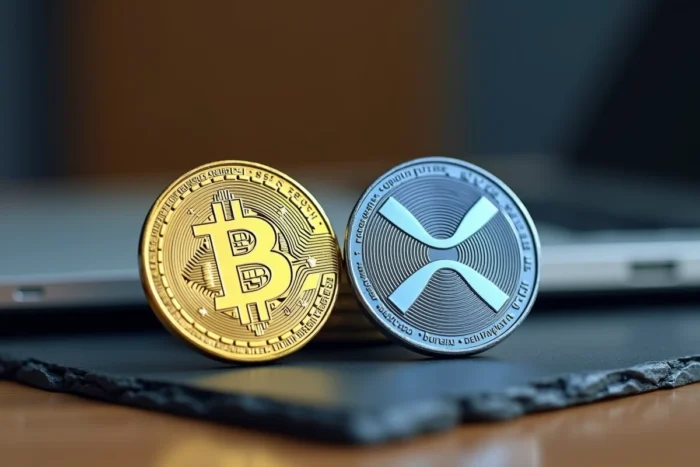
Bitcoin and XRP are not playing the same game. The former behaves like a macro asset, comparable to digital gold. The latter aims to become the preferred payment rail for banks and financial institutions. Comparing Ripple and Bitcoin is like opposing two visions of decentralized finance, with radically different mechanisms, uses, and risk profiles.
Low correlation between XRP and Bitcoin: an angle the market overlooks
Have you ever noticed that some cryptocurrencies rise together and then fall together? This phenomenon has a name: correlation. Two highly correlated assets move in the same direction at the same time.
Read also : Understanding the Side Effects After the Second Shingles Vaccine Injection
Between XRP and Bitcoin, this correlation is surprisingly low. Recent data indicates a correlation of about 0.16 between XRP-USD and BTC-USD. In simple terms, the price movements of one hardly affect the other.
Specifically, when Bitcoin stagnates or declines, XRP can very well progress, and vice versa. This relative independence changes the game for those building a crypto portfolio. Instead of choosing one over the other, analyzing the Ripple vs Bitcoin match from the perspective of complementarity offers a more nuanced view than simply betting on a single token.
See also : Inspiring Portraits: Discover the Unique Journeys of Innovative French Entrepreneurs
XRP also shows significantly higher volatility than Bitcoin. Over certain recent periods, its Sharpe ratio (the return/risk ratio) has been higher. Translation: XRP can offer a better risk-adjusted return, but with much more violent fluctuations.
Consensus mechanism: proof of work vs Ripple protocol
The internal workings of each network explain much of their differences. Bitcoin relies on proof of work. Thousands of machines solve complex calculations to validate each block of transactions. This mechanism consumes a tremendous amount of energy, but it guarantees maximum decentralization: no one controls the network.
XRP operates differently. The XRP Ledger uses its own consensus algorithm, where a group of validators approves transactions in a matter of seconds. No mining, no race for computing power.
- Transaction speed: XRP settles a transfer in three to five seconds, while Bitcoin requires an average of about ten minutes per confirmation.
- Cost per transaction: fees on the XRP network are negligible, while those of Bitcoin fluctuate according to network congestion and can become high during periods of strong demand.
- Energy consumption: the Ripple protocol consumes a fraction of the energy required for Bitcoin mining, a significant argument in the environmental debate surrounding cryptocurrencies.
However, this efficiency comes at a price. The XRP network is often criticized for its relative centralization. A limited number of validators control the consensus, whereas Bitcoin distributes validation across a global mesh of independent miners.
Tokenomics and supply: programmed scarcity vs controlled distribution
Bitcoin has a fixed cap of 21 million units. Each halving (the halving of the mining reward) reinforces this scarcity. This mechanism fuels the narrative of a deflationary asset, similar to gold.
XRP starts from an opposite scheme. All tokens were created at launch. Ripple Labs holds a significant share, released gradually through an escrow mechanism. This centralized management of supply worries some investors: Ripple’s distribution policy directly influences the price of XRP.
Why does this detail matter? Because an investor buying Bitcoin bets on increasing scarcity. One who buys XRP bets on the adoption of the Ripple network by financial institutions. The valuation drivers are not the same.

Regulatory landscape: the factor that changes XRP’s trajectory
The legal journey of Ripple has heavily influenced market sentiment around XRP. For several years, the litigation between Ripple Labs and the U.S. regulator created a gray area. Trading platforms hesitated to list or maintain the token.
The recent regulatory clarity has caused a significant rise in the price of XRP. This is no coincidence: institutional investors need legal certainties before allocating capital. The resolution of the regulatory conflict has unlocked a flow of institutional adoption for XRP.
Bitcoin, on the other hand, benefits from a more established status. It is recognized as an asset in most jurisdictions. The approval of spot Bitcoin ETFs in several countries has strengthened its legitimacy among traditional fund managers. From a regulatory standpoint, Bitcoin has a head start.
Bitcoin or XRP: two different bets on the future of blockchain
Choosing between Bitcoin and XRP is choosing between two distinct investment theses.
- Bitcoin attracts those seeking a decentralized store of value, resistant to censorship and monetary inflation. Its network is the oldest, most proven, and most decentralized.
- XRP appeals to those betting on the transformation of cross-border payments. Its speed, minimal fees, and partnerships with financial institutions make it more of an infrastructure tool than a speculative asset.
- In terms of risk profile, Bitcoin behaves like a macro asset while XRP remains a bet on the adoption of a specific ecosystem.
The question “who will win the battle” presupposes that only one can win. Correlation data suggests otherwise. These two cryptocurrencies operate on sufficiently independent trajectories to coexist in the same portfolio, each meeting a different need. The real risk would be to confuse them.