A wedding invitation comes back from the graphic designer, the envelopes are stacked on the table, and the question arises: do we write “Mr and Mrs Dupont” or “Monsieur and Madame Dupont”? This seemingly trivial detail affects the proper delivery of the mail and the impression the recipient will have of your sending. French postal rules and etiquette do not always say the same thing, and this is where mistakes multiply.
Optical sorting and readability: what La Poste really expects from your envelope
Before choosing between “Monsieur” and “Mr”, it’s helpful to understand how the mail is processed. La Poste sorts the majority of mail by automatic optical reading. The machines scan the address block line by line, and a poorly formatted address slows down or blocks sorting.
Further reading : Everything You Need to Know About the Non-Gage Certificate: Usefulness and Essential Steps
The technical constraints are precise: a maximum of six lines, thirty-eight characters per line (including spaces), no punctuation, no underlining, no italics. The last three lines (number and street, postal code and city, country if international) must be written in uppercase. The alignment is to the left.
Knowing that addressing errors are increasingly not corrected by hand (manual sorting staff has decreased), taking care with the recipient line becomes a profitable reflex. An “M. and Mme” attached to a street line that is too long can cause the entire street reading to fail. Knowing how to write an address on an envelope mr and mme while respecting these technical constraints avoids many mail returns.
Recommended read : Everything You Need to Know About the Westie: Temperament, Breeding Tips, and Tricks for Your Companion
Monsieur and Madame in full: the etiquette rule on a wedding envelope
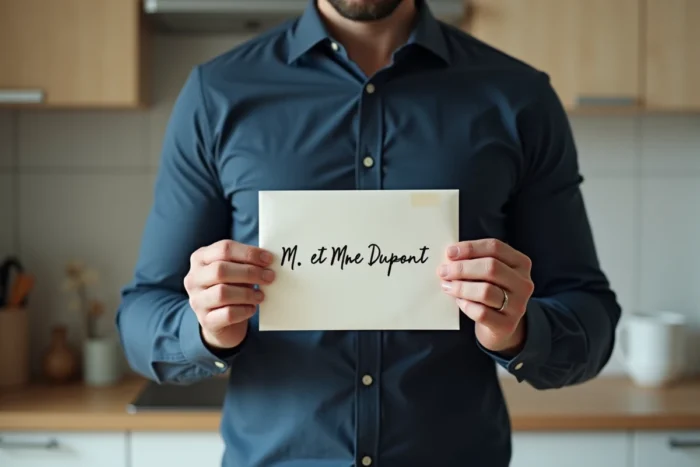
On ordinary administrative mail, the abbreviations “M.” and “Mme” pass without issue. For an invitation, a wedding announcement, or any somewhat formal sending, we write “Monsieur and Madame” in full, without abbreviation. It’s a matter of politeness, not a postal obligation, but it remains firmly rooted in French customs.
Order of names and choice of surname
The classic usage places “Monsieur” before “Madame” on the envelope. Nothing prohibits the reverse, but the convention remains dominant in the context of marriage. The common surname is used if the couple shares the same name, or both names if each has kept theirs.
- “Monsieur and Madame Dupont” when the couple has the same last name
- “Monsieur Dupont and Madame Durand” when the names differ (bride has kept her name, unmarried couple)
- “Monsieur and Madame Dupont-Durand” if the couple uses a hyphenated surname
The first name is not mandatory on the recipient line. It is added when several Dupont families live at the same address or when one wants to personalize the sending. In this case, the first name is placed before the last name: “Monsieur Jean and Madame Marie Dupont”.
Envelope addressed to a family with children
To invite a couple and their children, one can add a line under the parents’ names. The phrase “and family” works but remains vague. Mentioning the children’s first names on a separate line (“Léa, Hugo and Emma”) is warmer and clearly indicates that the children are invited.
Common mistakes on Mr and Mme envelopes and how to correct them
The same mistakes are found on dozens of batches of invitations each season. Here are the most common, along with the associated corrections.
Incorrect abbreviations
“Mr” is an English abbreviation for “Mister”. In French, the correct abbreviation for “Monsieur” is “M.” with a period, never “Mr” or “Mr.”. For “Madame”, it’s “Mme” (without a period). The mistake is so widespread that it often goes unnoticed, but on a well-prepared envelope, it stands out.
Line too long
With two last names, a compound street number, and an address complement, one quickly exceeds thirty-eight characters. The solution: use standardized postal abbreviations for the street (BD for boulevard, AV for avenue, RUE remains as is) and place the address complement (building, staircase, floor) on a separate line.
Incorrectly placed uppercase letters
Only the last three lines of the address should be in uppercase according to La Poste’s recommendations. The line “Monsieur and Madame” remains in normal case (initial capital letter, lowercase afterwards). Writing the entire address in capitals reduces optical readability instead of improving it.
Complete address model for a couple on an envelope
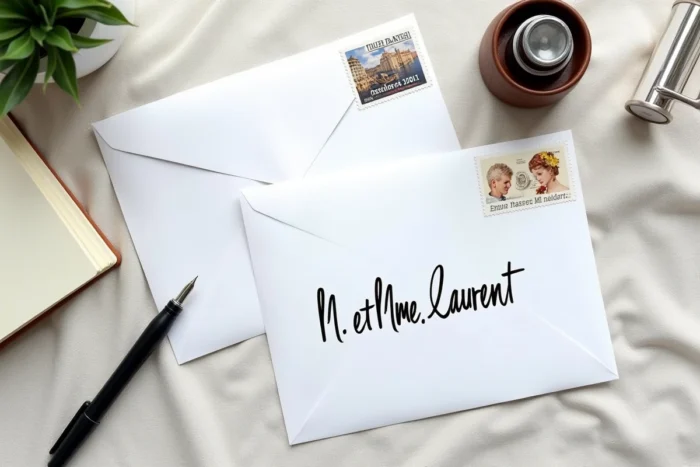
A concrete example is worth more than a long explanation. Here is the recommended format, line by line:
- Line 1: Monsieur and Madame Dupont
- Line 2: Apartment 4B (address complement, if necessary)
- Line 3: 12 RUE DES LILAS
- Line 4: 75011 PARIS
We stay at four lines here because there is no locality or post office box. If the couple lives in a rural area with a locality, that will take an additional line, just before the street.
For an international sending, we add the country on the last line, in uppercase, in the language of the country of dispatch: “FRANCE” if sending from abroad to France, “BELGIQUE” if sending to Belgium from France.
Special cases after a marriage: maiden name and usage name
After a marriage, the bride may have adopted her spouse’s name as a usage name, retained her birth name, or chosen a double name. None of these situations change the writing rules on the envelope: we use the name under which the person receives their mail, the one that appears on their mailbox.
In case of doubt, the safest formula remains “Monsieur and Madame” followed by the name on the mailbox. If the names differ, they are separated with “and” without a comma. We avoid constructions like “Madame Durand née Martin” on an envelope: that is reserved for official documents.
Returns vary on this point, especially when the couple has just married and the mailbox has not yet been updated. In this case, adding both names on the same line remains the most reliable solution for the postman to identify the recipient.