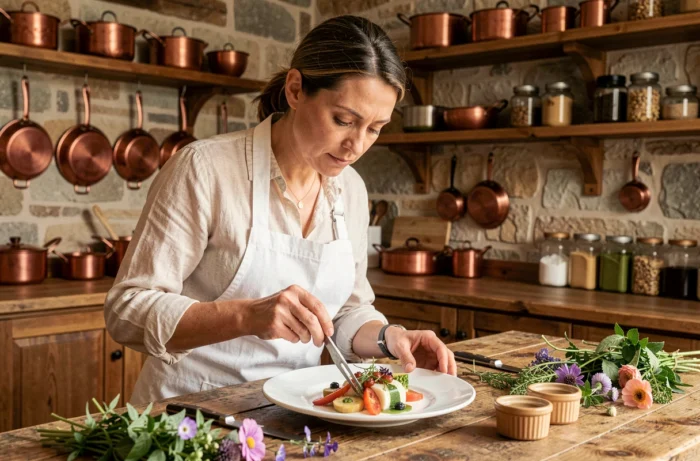
The Cicada and the Fork is a restaurant rooted in Ardèche, in Larnas, that builds its cuisine around local products and a creative approach to French gastronomy. Its universe is based on a balance between culinary tradition and freedom of interpretation, in a setting where the meal becomes a moment in its own right.
Local Cuisine: What the Ardèche Terroir Changes on the Plate
A restaurant that claims to serve local cuisine does not merely mention the origin of its products. The choice of the Ardèche terroir imposes concrete constraints on the menu: strict seasonal availability, plant and animal varieties unique to the south of the Auvergne-Rhône-Alpes region, and short supply chains that alter the rhythm of the menus.
Ardèche is among the French departments best positioned in terms of eco-responsible tourism and organic production. This density of producers committed to sustainable practices offers local restaurateurs direct access to quality raw materials, without going through the long supply chains of large distribution.
To learn more about The Cicada and the Fork, the restaurant’s cuisine page details the table’s orientations and the chef’s choices. What distinguishes this approach is the ability to adapt the menu not weekly, but daily, according to actual arrivals.
Creative French Gastronomy: Between Classic Dishes and Free Interpretations
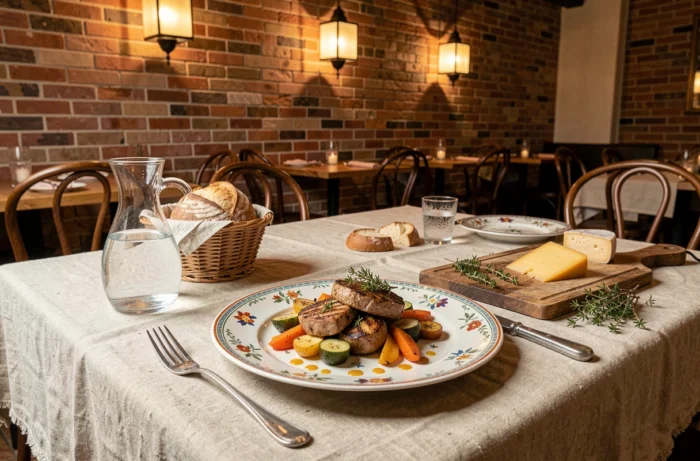
The creative French gastronomy practiced at The Cicada and the Fork is not about visual spectacle for its own sake. The chef’s work consists of starting from a classic base (a stock, a sauce, a mastered cooking technique) and then shifting one or two elements: an unusual condiment, a combination of textures, a wild product foraged nearby.
This method requires solid technical mastery. A seasonal dish built around a unique product (an heirloom vegetable, a locally aged goat cheese) requires fewer ingredients but more precision in cooking and seasoning.
What Structures a Seasonal Menu in Ardèche
Seasonality is not limited to changing side vegetables. It alters the entire logic of the meal:
- In summer, dishes lighten and favor short cooking times, fresh herbs, and stone fruits from southern Ardèche, with plates designed for the terrace.
- In autumn and winter, long preparations (braises, confits, broths) take precedence, featuring products like chestnuts, local squashes, and forest mushrooms.
- In spring, the menu plays on the transition: first green vegetables, young shoots, the return of wild herbs, in brighter and more tangy combinations.
Each season imposes a different culinary vocabulary, and the restaurant adapts its techniques accordingly rather than imposing a single style throughout the year.
Organic and Short Supply Chains in Catering: A Favorable National Context
The organic positioning of The Cicada and the Fork is part of a broader dynamic. According to the Agence Bio, the share of organic products in French household consumption has been on the rise since 2024-2025, after a dip in previous years. This recovery particularly concerns local supply chains and specialized shops.
For a local restaurant, this means a double advantage: a clientele increasingly sensitive to the origin of products, and a network of local suppliers that is structuring and professionalizing. The many organic producers in Ardèche provide a reliable network for regular supply.
The Tension Between Organic Ambition and Ground Reality
Despite this favorable trend, the EGAlim law sets ambitious goals for collective catering, but statistical reports show a persistent gap between legal objectives and reality. Associations have filed complaints against the state for failing to meet its own obligations regarding organic products in school cafeterias.
A private restaurant like The Cicada and the Fork is not subject to these legal obligations. Its choice of organic products is a voluntary approach, giving it a coherence that collective catering still struggles to achieve. This distinction deserves to be understood by diners questioning the reality of organic in their plates.
Lunch or Dinner at The Cicada and the Fork: The Dining Experience
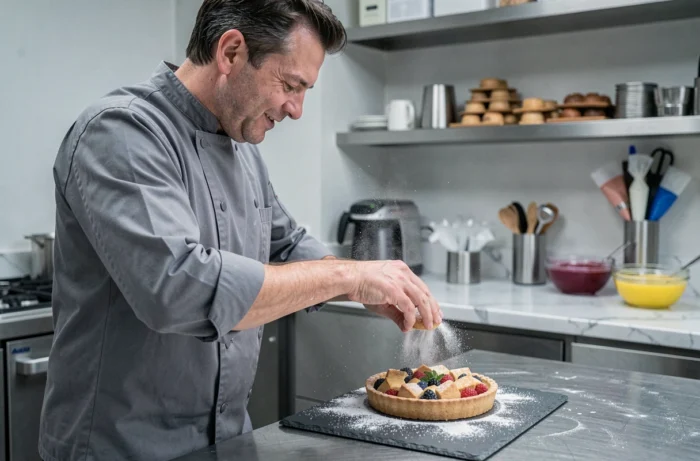
The restaurant offers lunch and dinner options, with a menu whose average budget is within an accessible range for a table of this quality. The dining room and terrace provide two distinct atmospheres depending on the time of day.
In the morning and at noon, the natural light of the place highlights the plates and creates a relaxed atmosphere. In the evening, the ambiance changes: a more composed service, often more elaborate dishes, and the possibility of dinner-shows that add a cultural dimension to the meal.
Recurring reviews on specialized platforms highlight the quality of the welcome and the consistency of the French cuisine served. The presence of high chairs and wheelchair accessibility reflects attention to practical details that complement the gourmet experience.
The establishment remains closed on Wednesdays, a logistical detail that allows the chef and his team to prepare the week’s supplies and work on new creations. This breathing time is reflected in the freshness of the dishes offered in the following days, a operational choice that prioritizes quality over volume.