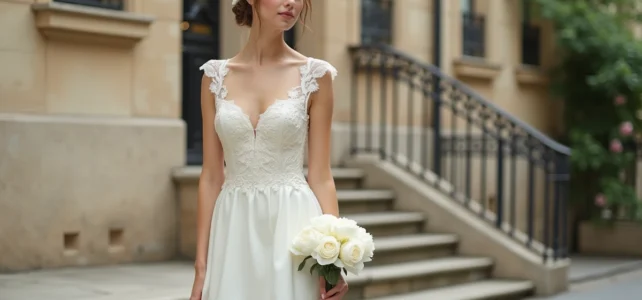
The short wedding dress poses a technical question before it becomes a style question: what corset construction, what fabric choice, and what hem length produce a result that holds up in photos and in motion, without tipping into cocktail territory? We observe that the majority of casting errors stem from a misreading between the cut and the body shape, not from a lack of boldness.
Fabric choice and corset fit on a short wedding dress
On a long dress, the volume of the skirt compensates for a soft fabric or a rough corset. On a short dress, every structural flaw is immediately visible. The boned corset in mikado or faille remains the most reliable technical base for a model above the knee: it supports the bust without stiffening the silhouette.
Read also : How long does a rechargeable hybrid battery last and what factors influence it?
Calais lace or guipure work well as an overlay, provided they are lined with a sufficiently dense fabric. Lace placed directly over a thin lining creates a transparent effect in bright sunlight, a common pitfall for entry-level models.
Crape offers a clean drape, suitable for straight or slightly flared cuts. We recommend it for summer ceremonies, especially since the recurring heat episodes since 2023 are pushing more brides towards breathable materials. Duchess satin, on the other hand, marks every crease: it requires impeccable cutting and last-minute ironing, making it less practical for a long day.
Read also : How to Withdraw Your Child from School: Steps, Consequences, and Practical Tips
To explore the different options for silhouettes and finishes, the wedding guide on 123 Mariages details the fabric-cut associations according to the type of ceremony.
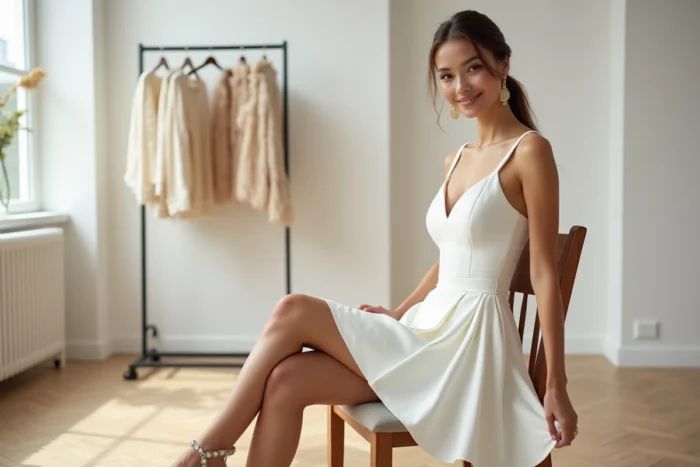
Hem length and body shape: technical guidelines
The hem length determines the dress’s style far more than any decorative detail. Three levels produce radically different effects.
- The mini (above the knee, about mid-thigh) works on elongated silhouettes and very casual weddings. It requires low shoes or fine-strapped sandals to avoid overwhelming the leg.
- The just above the knee (two to three centimeters) is the most versatile level. It visually elongates the leg without exposing as much as a mini, and is suitable for both a civil wedding and an outdoor secular ceremony.
- The midi (mid-calf) leans towards a retro style. It requires a heel to avoid the “skirt cut too early” effect, especially on shorter body shapes.
The basic rule remains simple: the hem should fall at a point where the leg is slim (above the knee or at the ankle), never at the widest point of the calf. This principle applies regardless of the chosen style.
Sleeves and armholes on a short cut
Long lace sleeves on a short dress create a covered/revealed contrast that structures the look. Conversely, a strapless bodice on a mini can lack construction if the corset is not sufficiently crafted.
Three-quarter sleeves in organza or illusion tulle represent a solid technical compromise: they dress the arm without adding volume at the shoulders. For civil ceremonies where the dress code remains understated, a structured short sleeve (like a cap sleeve) is enough to anchor the dress in the bridal realm.
Short wedding dress for civil wedding and the practice of the double look
The practice of changing outfits between the town hall and the secular or religious ceremony has significantly developed in recent years. Specifically, the bride wears a chic short dress for the civil wedding, then slips into a long dress for the rest of the day.
This double look imposes a constraint often overlooked: the hairstyle and makeup must work with both dresses. A structured low bun transitions from one style to another without retouching. A long veil, on the other hand, does not pair with a short dress without creating a proportion imbalance.
Accessories play a linking role between the two outfits. A pair of statement earrings worn with both dresses ensures visual coherence. Shoes can change: high heels for the ceremony, a lower model for the town hall.
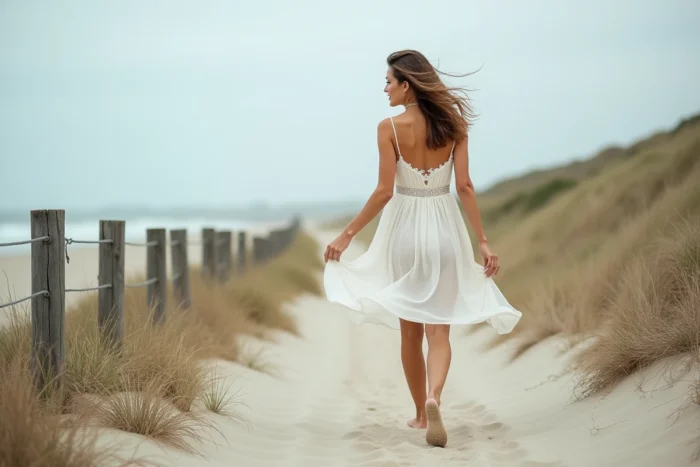
Details and accessories that anchor the bridal style
A short white dress without bridal markers resembles an evening outfit. It is the details that shift the dress into the wedding realm: a back adorned with covered buttons, a satin belt with a flat bow, tone-on-tone embroidery at the neckline.
Short veils (shoulder or elbow length) work with dresses above the knee. Long veils, cathedral or chapel, create a proportion imbalance that no styling can truly correct.
- A beaded headband or a discreet floral comb is a great alternative to the veil for a civil wedding.
- Short satin gloves add a retro touch that is consistent with a midi model.
- A rigid clutch (like a minaudière) completes the silhouette better than a voluminous bouquet, especially on a mini.
The choice of shoes deserves as much attention as the dress itself. On a short model, the legs are a direct extension of the outfit. Pointed nude heels elongate the line, while thick platform sandals break the fluidity of the silhouette.
The short wedding dress does not forgive sloppiness in the finishes. A poorly calibrated hem of two centimeters, a wrinkled fabric, or accessories out of place are enough to derail the result. Every technical detail matters more than on a long dress, precisely because nothing is hidden behind volume.