
A teacher starting their day has already prepared their lessons, responded to emails from parents, and updated a digital tracking notebook. Even before the first bell rings, the mental load is there. Understanding the challenges faced by teachers requires going beyond the discourse on vocation to look at what, concretely, makes daily life difficult.
Psychosocial risks in schools: a recent obligation for prevention
Chronic stress, burnout, conflicts with families or hierarchy: these situations are no longer just individual feelings. They are now framed by legal obligations for prevention for public employers.
See also : Why the hedgehog huffs: understanding the different sounds in case of danger
The regulations require the creation and updating of a Single Document for Professional Risk Assessment (DUERP), which must include the psychosocial risks specific to the teaching profession. This means that each institution is required to identify factors of stress, violence, or overload, and then plan preventive actions.
Have you heard about the DUERP in your school? In the Vienne department, it is planned that by 2026-2027, all schools will dedicate at least three hours of pedagogical training to this document. The prevention of professional risks is becoming an explicit subject of training, no longer a marginal topic addressed at the end of meetings.
Recommended read : Everything You Need to Know About Article 16 of the Code of Civil Procedure and Its Implications
The problem is the gap between the legal framework and the reality on the ground. Many teachers are unaware of the very existence of the DUERP in their institution. The tool exists, but its adoption remains slow. As long as teams are not trained to take it up, it remains just another administrative form. To better understand the challenges faced by teachers, we must observe how these preventive tools struggle to become embedded in practice.
Replacement of absent teachers: a daily management problem
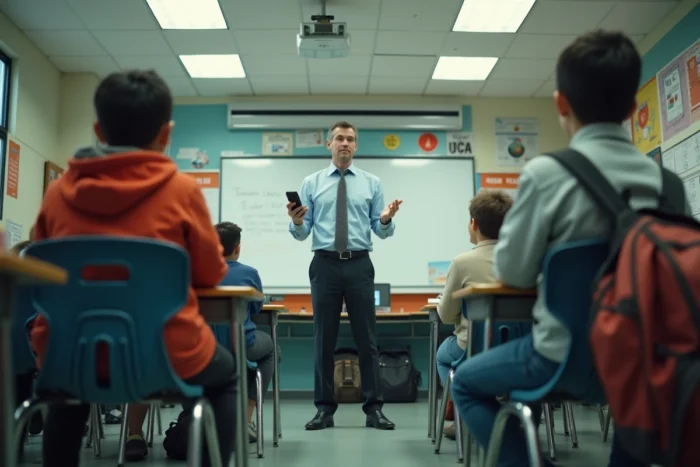
When a teacher is absent, the class does not disappear. The students are there, parents are waiting for a solution, and the administration improvises. The replacement of absent teachers is one of the most concrete points of friction in the French education system.
The Ministry of National Education claims that the situation has improved. Field data tells a more nuanced story. The use of contract workers, that is, individuals hired without competitive exams to fill vacant positions, increases year after year.
What this means for permanent teachers
A permanent teacher in an institution where replacements are delayed faces dual pressure. They sometimes have to welcome additional students into their own class or ensure pedagogical continuity for an absent colleague, without any time off.
This overload is not trivial. It eats into preparation time, lengthens the days, and feeds the feeling that the system works thanks to individual goodwill rather than reliable organization. The absence of a colleague becomes a collective problem that each team member absorbs.
- Welcoming additional students on short notice, sometimes from different levels, complicating classroom management.
- Loss of time for collaboration among colleagues, as free slots are used to compensate for absences.
- Increased feeling of professional isolation, with each teacher managing the overload on their own.
Continuing education and the gap between theoretical knowledge and classroom practices
The initial training of teachers is often described as fragmented. Research highlights a problematic division between two types of content: theoretical knowledge about teaching (didactics, learning psychology) and knowledge derived from daily classroom practice.
In practice, a trainee teacher may take a module on pedagogical differentiation without ever having observed an experienced colleague implement it in a class of 28 students. The link between the theory learned in training and the reality experienced in the classroom remains too tenuous.
Artificial intelligence in the classroom: opportunity or additional burden
The arrival of artificial intelligence tools in education illustrates this gap well. Applications promise to adapt exercises to each student’s level or facilitate school inclusion. On paper, this is appealing.
In practice, using these tools requires time for familiarization, reliable equipment, and training that most teachers have not received. AI in education also raises ethical questions (protection of student data, the role of humans in the educational relationship) that teams must address without a clear framework.
The result: an innovation intended to lighten the workload can, at first, make it heavier. Any new technology in the classroom requires support that is still lacking in many institutions.

Recognition of the teaching profession: the gap between mission and social perception
In France, a very small proportion of teachers believe that their profession is valued in society, well below the average observed in OECD countries. This figure reflects a deep malaise.
This is not just a question of salary, although perceived insufficient remuneration weighs heavily. It is also about the deteriorating relationship with the hierarchy, increasing tensions with some families, and the feeling of not having the means to do their job well.
- Remuneration perceived as disconnected from the level of qualification required and the actual workload.
- Relationships with parents that have transformed: more contestation of pedagogical decisions, sometimes aggressively.
- Lack of hierarchical support in crisis situations, reinforcing the feeling of abandonment.
Many teachers do not regret choosing this path. The educational mission retains its meaning. But the imbalance between the demands of the profession and the recognition given wears down motivation in the long term. It is not a loss of love for teaching, but a fatigue in the face of the conditions under which it is practiced.
The teaching profession has not lost its nobility. What has changed is the accumulation of administrative, technological, and relational constraints that pile up without adequate resources. As long as risk prevention remains just a form, replacements rely on improvisation, and training ignores the daily realities of classrooms, these challenges will remain structural obstacles rather than temporary difficulties.