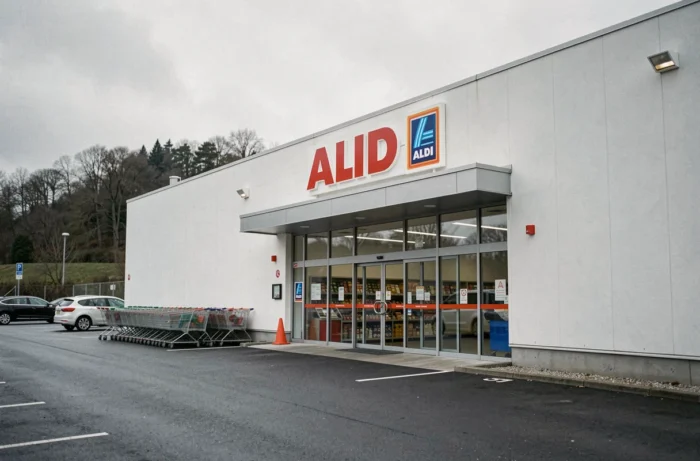
Aldi refers to two distinct companies, Aldi Nord and Aldi Süd, originating from the same family grocery store founded in 1913 in Essen, Germany, by the Albrecht family. In France, it is the Aldi Nord branch that operates the store network. The model is based on a principle formulated as early as 1947 by brothers Karl and Theo Albrecht: to reduce operating costs to the strict minimum in order to offer permanently low prices, without spectacular promotions or unnecessary decor.
Why Aldi Nord and Aldi Süd are two separate companies
The split dates back to 1961. Karl and Theo Albrecht, who jointly managed the family group, separated over a disagreement regarding the sale of cigarettes in stores. Theo, in favor, took the helm of Aldi Nord. Karl retained Aldi Süd.
This division is not merely anecdotal. It still structures the global geographical distribution of the brand today. Aldi Nord operates in France, Belgium, Spain, and Portugal, while Aldi Süd covers Australia, the United Kingdom, and the southern region of Germany. The two entities share the name and discount philosophy but operate with independent management, suppliers, and business strategies.
To understand the history and positioning of Aldi stores in France, this distinction between the two branches remains a useful starting point: decisions made in Essen for Aldi Nord do not follow the same logic as those from the Aldi Süd headquarters in Mülheim.

The Aldi discount model: limited assortment and private labels
The operation of an Aldi store is based on a principle that the retail sector calls hard discount. The concept relies on three interdependent mechanisms.
- A limited assortment, focused on fast-moving consumer goods. While a hypermarket lists several tens of thousands of products, an Aldi store offers a fraction, simplifying logistics and reducing inventory management costs.
- A predominance of private labels. The majority of items on the shelves carry the store’s own brands, eliminating margins paid to large food groups and allowing for direct negotiations of specifications with suppliers.
- A minimalist store layout. Products are often displayed on pallets or in their original cartons, staff are versatile (cashier, stocking, receiving), and the sales area remains modest.
This triptych allows Aldi to maintain sustainably low prices without resorting to the aggressive promotional operations practiced by other brands. Low prices are not a promotion; they are the normal operation of the model.
Aldi vs. Lidl in the French retail market
In France, Aldi has long been outpaced by Lidl, its direct German competitor, which also comes from the hard discount sector. Lidl has invested heavily in upgrading its stores, expanding its assortment, and television advertising. Aldi has followed a different, more gradual trajectory.
The brand has undertaken a renovation program for its points of sale, with complete reconstructions of some stores in internationally standardized formats. In Yutz, Lorraine, a large store has been rebuilt to replace the old format. In Calonne-Ricouart, Pas-de-Calais, the reopening of the Aldi store, the only business in the town, was eagerly awaited by residents after a period of renovations.
Aldi is modernizing its stores without abandoning the principle of discount pricing. The new locations are brighter and better organized, but the assortment remains deliberately tight and private labels still dominate the shelves.

Aldi stores in city centers: the shift towards urban proximity
The most recent evolution concerns geographical placement. Historically located on the outskirts and in commercial zones, Aldi is now opening stores in densely populated urban areas, designed for everyday shopping.
The store in Lille, on rue de Saint-Quentin, opened in early September 2026, illustrates this strategy. Located immediately near the metro, it offers extended hours until 9 PM on weekdays, an unusual range for a discounter. This format explicitly targets quick purchases after work, not large weekly shopping trips.
This shift changes the very nature of competition. In city centers, Aldi is no longer only competing with Lidl but also with convenience stores like Franprix, Carrefour City, or Monop’. The price argument then becomes a powerful lever against nearby brands whose prices are significantly higher.
What this format changes for the customer
An urban Aldi store retains the logic of a reduced assortment. Customers will not find the depth of range of a traditional supermarket. However, everyday products (fruits, vegetables, dairy products, basic groceries) are available at prices aligned with the discount model, in a setting accessible without a car.
Urban proximity represents a change in positioning, not in the economic model. The mechanism remains the same: reduced costs, private labels, limited assortment. Only the location changes.
Aldi builds its French development on a consistency rarely contradicted since the Albrecht brothers: low prices as a consequence of a system, not as a one-off marketing argument. Recent openings in city centers show that this logic adapts to new territories without diluting. The Lille store, with its extended hours and metro location, provides a concrete idea of the direction taken by the discount brand in the French market.