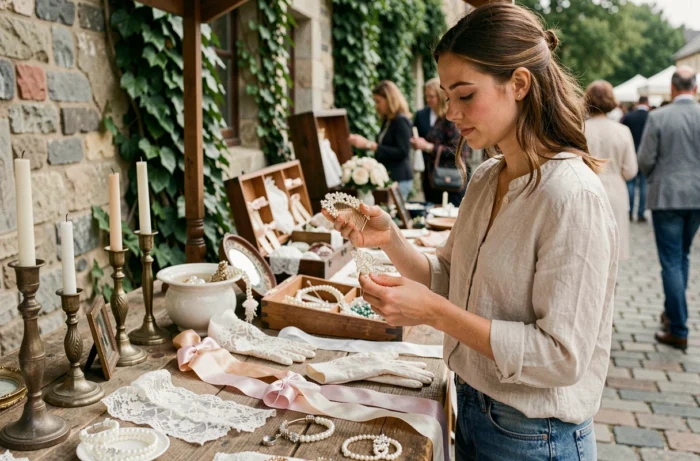
The average budget for a wedding in France drives many couples to seek concrete ways to reduce costs. Among the less documented options, buying and reselling wedding accessories forms a circuit that allows recovering a significant portion of the initial investment. Decorations, disposable tableware, arches, photo accessories: these items represent a real cost, but their usage duration often limits to just a few hours.
Reselling in bulk after the wedding: a structured circuit
Articles on budget weddings mention second-hand items vaguely. What they do not address is the rise of specialized marketplaces for events, where newlyweds resell all their decoration stock at once. Platforms like Eventsmarket display listings of complete lots (arch, centerpieces, covers, candles) with the initial purchase price and resale price, making the calculation of net cost transparent.
The advantage of bulk resale lies in a simple argument for the next buyer: a ready-to-use kit for a complete wedding saves dozens of hours of sourcing. This argument justifies a resale price higher than the sum of the pieces sold separately. For the selling couple, grouping all accessories into a single listing also reduces the time spent managing transactions.
On Troc Mariage, this logic of circulating accessories between couples is at the heart of its operation: items pass from one wedding to another, creating a form of circular economy specific to the wedding sector.

Tax threshold on online sales: what the 30 transaction rule changes
A rarely discussed point in budget wedding guides concerns the tax regulations applicable to sales between individuals. Online resale platforms are required to report to the tax administration users who exceed a double threshold during a calendar year. This threshold is set at 30 sales or 2,000 euros in revenue on the same platform.
For a couple reselling their wedding decorations, the risk of exceeding this threshold exists if the accessories are listed for sale item by item on multiple platforms. Reselling in a single bulk lot, in addition to being more commercially efficient, limits the number of reportable transactions.
Occasional sale or regular activity
The distinction is clear in tax law. Selling one’s own used goods at a price lower than the purchase price falls under occasional sales and is not taxable. In contrast, buying accessories with the intention of reselling them for a profit constitutes a commercial activity, even if occasional. Field reports vary on this point: some couples intentionally buy second-hand lots to resell after use, without always realizing that this operation can be reclassified.
- The resale of personal items used for one’s own wedding, at a price lower than the purchase price, does not generate income tax.
- Buying accessories with the intention of using them and then reselling them for profit may be considered an occasional commercial activity.
- Exceeding the threshold of 30 sales or 2,000 euros triggers an automatic report from the platform to the tax administration.
Wedding accessories with high resale value: which items to prioritize
Not all accessories resell with the same ease. Bulky and photogenic items (floral arches, giant illuminated letters, customizable welcome signs) find buyers quickly because they are expensive to buy new and difficult to make oneself.
The wedding dress remains the most documented item in second-hand sales. Other categories deserve more attention for a net cost calculation:
- Reception tableware and glassware bought in bulk (plates, stem glasses, carafes) resell well if they are of a common model and without chips.
- Signage elements (table numbers, seating plans on wood or acrylic supports) are sought after by couples who want a polished look without going through a graphic designer.
- Photobooth accessories (frames, signs, hats, glasses) have a long lifespan and low unit cost, allowing for quick bulk resale.
On the other hand, consumables (partially melted candles, confetti, used artificial petals) and personalized stationery (invitations, named menus) have no resale value. Focusing the budget on reusable accessories is the main lever to reduce the net cost of the wedding.
Buying second-hand before the wedding: assessing the actual condition of accessories
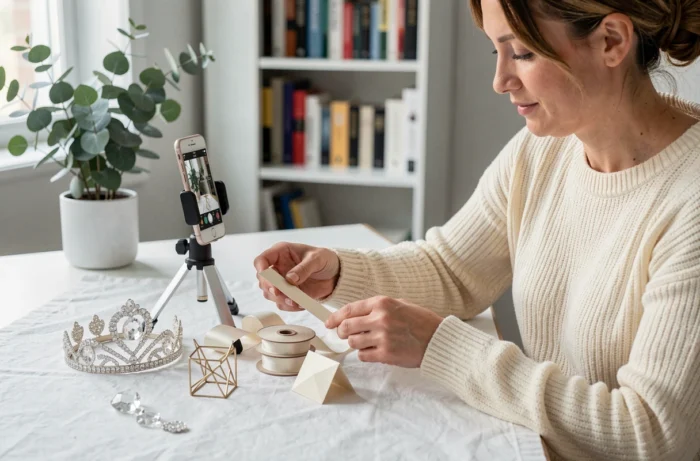
Buying second-hand wedding accessories exposes one to the risk of discrepancies between the listing photo and the actual condition. Fabrics (tablecloths, runners, drapes) are the most affected: stains, marked folds, prolonged storage odors. Available data does not allow for a conclusion on an average dispute rate, but several bride forums report disappointments regarding chair covers and drapery.
For rigid items (vases, frames, seating plan supports), the condition is easier to verify in photos. Requesting pictures from multiple angles and in natural light reduces the risk. For bulky lots, picking up in person is preferable to shipping, which adds a sometimes discouraging transport cost.
The right time to buy and resell
The demand for wedding accessories follows a marked seasonality. Purchases concentrate between January and May, before the peak wedding season. Posting resale listings as early as September allows capturing couples preparing for a wedding the following year, when competition among sellers is still low.
Buying in the fall, after the post-summer resale wave, provides access to abundant stock and lower prices. This few-month gap between purchase and ceremony also allows time to check the condition of items, complete a lot, or replace a defective element without urgency.
The net cost of a wedding depends less on the initial budget than on the ability to circulate accessories after the celebration. A couple that buys a complete second-hand lot, uses it on the big day, and then resells it in the weeks that follow can bring the decoration cost down to a fraction of its catalog price. The main constraint remains the time spent on listings and logistics, a factor that each couple must weigh before committing to this approach.