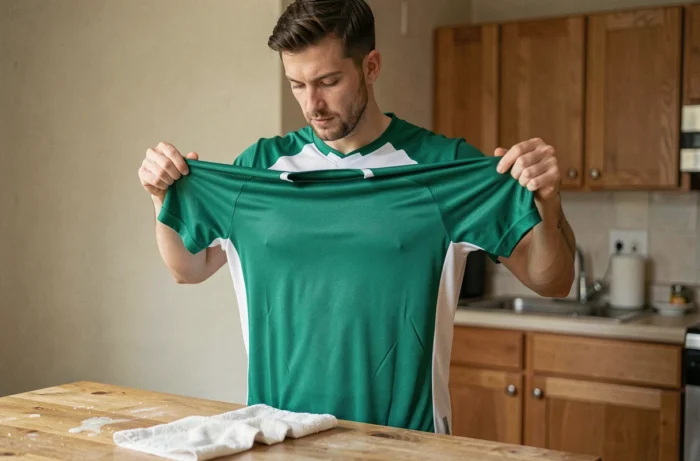
A football jersey that is too tight poses a real problem: wearing it becomes uncomfortable, and selling or donating it is not always an option when it comes to a collector’s item or a personalized jersey. Expanding a football jersey without damaging it requires understanding how the synthetic fibers that make up almost all current jerseys react.
The techniques that work on cotton do not produce the same results on polyester, and some may damage heat-pressed markings.
Polyester and technical fibers: why a football jersey resists stretching
The majority of football jerseys sold over the past decade are made from polyester, sometimes blended with elastane. This synthetic fabric has a much better shape memory than cotton. When you pull on a polyester jersey, the fibers stretch slightly and then return to their original position once the tension is released.
Manufacturers like Nike and Adidas design their jerseys to maintain their shape despite repeated washing. Recent care guides from these brands consistently recommend washing in cold water around 20 to 30 °C, without fabric softener, and air drying in the shade. These instructions are specifically aimed at preventing any deformation of the fabric and decorations.
This resistance to deformation complicates matters when trying to gain half a size or a full size. Knowing how to enlarge a football jersey starts with identifying the fabric: a vintage cotton jersey will react very differently from a recent technical jersey.
Soaking and cold stretching: the least risky method for the fabric
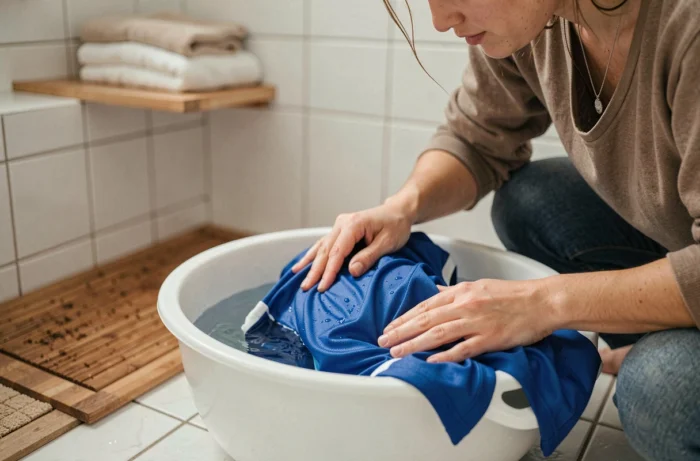
The gentlest technique involves soaking the jersey in lukewarm water (never hot) for about twenty minutes, then stretching it manually while flat. The water temporarily softens the fibers and provides a window during which a bit of width can be gained.
Concrete steps for soaking
- Fill a basin with lukewarm water and add a small amount of conditioner or white vinegar, which act as softeners on the fibers without damaging the markings
- Immerse the jersey for fifteen to twenty minutes, gently handling it to ensure the product penetrates evenly into the fabric
- Gently squeeze without twisting, lay the jersey flat on a towel, and carefully stretch it widthwise while holding the tension with heavy objects at the ends
- Let it dry completely flat, away from direct sunlight and any heat source
The gain achieved remains modest: we are talking about an expansion of a few centimeters, not a complete size change. On a pure polyester jersey, the fibers partially regain their original shape after drying. Sometimes the operation needs to be repeated two or three times for a lasting result.
Heat and football jerseys: the real risks to prints and badges
Several online guides suggest using a tumble dryer or an iron to soften and stretch a jersey. This approach poses a serious problem for modern jerseys. Sponsor markings, printed numbers, and badges are generally heat-pressed or sublimated onto the fabric.
Applying direct heat can detach or crack these decorative elements. Manufacturer recommendations explicitly prohibit ironing on printed areas. A high-temperature tumble dry may also cause the polyester to shrink, which would produce the opposite effect of what is desired.
If you still choose a method involving heat, caution dictates that you turn the jersey inside out, place a damp cloth between the iron and the fabric, and never exceed a low temperature. Field reports vary on this point: some achieve a slight gain, while others observe irreversible damage to the prints.
Sewing and adding a side panel: the only solution for a real size change
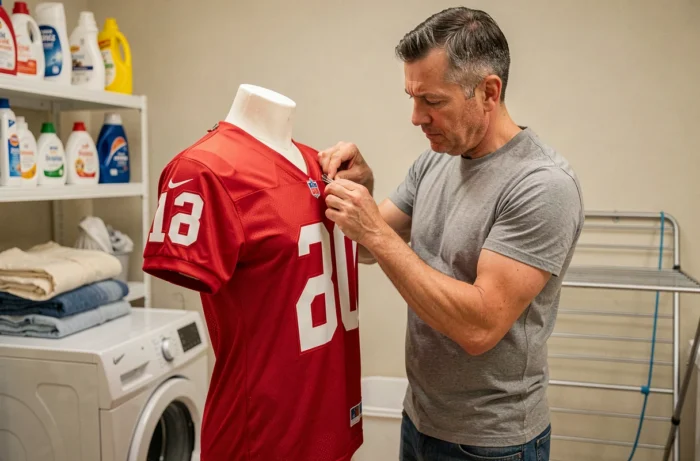
When the gap between the jersey size and the wearer’s size exceeds a few centimeters, stretching methods are no longer sufficient. The only approach that allows for significant and permanent widening involves opening the side seams and inserting a fabric panel.
Choosing the fabric for the panel
The added panel must be made from stretch fabric compatible with the jersey’s polyester. A four-way stretch sports mesh fabric offers the best result. Using cotton would create an area that absorbs sweat differently and would deform in the wash, creating a visible imbalance.
Limits of sewing alterations
Unpicking an overlocked seam on a technical jersey requires precision. The industrial seams of jerseys are often made with an overlock machine, and undoing them without damaging the adjacent fabric requires a fine seam ripper and patience. A tailor or seamstress experienced with sportswear will achieve a cleaner result than an amateur intervention.
The cost of professional alteration remains to be assessed on a case-by-case basis, but it is generally lower than purchasing a new official jersey. For a collector’s jersey or a vintage model that is no longer sold, sewing alterations often represent the best compromise between preservation and comfort.
Preventing the problem: choosing the right size before purchase
Football jersey sizes vary significantly from one brand to another and from one season to the next. The so-called “player” cuts (worn on the field) are much more fitted than the “fan” or “supporter” versions of the same model.
- Consult the size guide specific to each manufacturer rather than relying on your usual size in casual clothing
- Measure your chest circumference and bust length, then compare with the manufacturer’s chart
- If in doubt between two sizes, opt for the larger size, as shrinking an oversized jersey is easier than enlarging one that is too small
Recent football jerseys are designed to resist deformation. This technical quality, welcome on the field, becomes an obstacle when trying to modify the fit after purchase. Adapting expectations to the fabric composition and choosing the right method according to the jersey material remains the best guarantee of a satisfactory result without damage.