
Strengthening family ties on a daily basis rarely encounters a lack of goodwill. The problem lies more in the constant collision between staggered schedules, accumulated fatigue during the week, and the growing presence of screens in every room of the house. A synthesis published by Psychologies in 2024 points out that the regularity and predictability of shared times matter more than their total duration in consolidating family attachment.
Family Micro-Rituals: Structuring Connection When Time is Short
Waiting for the weekend or holidays to “spend time with family” often means indefinitely postponing that moment. Families whose schedules do not coincide benefit more from short but recurring time slots, anchored in the existing routine.
Recommended read : How to Withdraw Your Child from School: Steps, Consequences, and Practical Tips
A five-minute breakfast ritual (where everyone mentions an anticipated event in their day) or a quick round at dinner produces a cumulative effect on the quality of family relationships. The key lies in repetition, not in the ambition of the program.
You can check the Buzz Stream website for concrete ideas for rituals adapted to the constraints of contemporary family life.
Related reading : Discover the best beauty tips to enhance your daily routine
Several recent French-speaking resources also offer simple domestic mediation tools: the “talking round” at dinner, the “discussion corner” (a designated physical space for important exchanges), or the rotating designation of a “mediator of the day” among the children. These tools formalize communication without turning the home into a meeting room.
Screen-Free Time Slots: An Explicit Ritual Rather Than a Vague Rule
Saying “we should look at our phones less” doesn’t work. Families that achieve concrete results transform this intention into a structured time slot: a defined daily moment when all devices are placed in one location.
A daily phone-free time slot works better than a permanent ban. The difference lies in predictability: each member knows when the time slot starts and when it ends, which reduces resistance, especially among teenagers.
Field feedback varies on the ideal duration of this time slot. Some families maintain a full hour, while others limit it to mealtime. The format matters less than the non-negotiable nature of the ritual. Once established, it becomes a shared reference point.
What Fills the Time Slot Matters as Much as the Absence of Screens
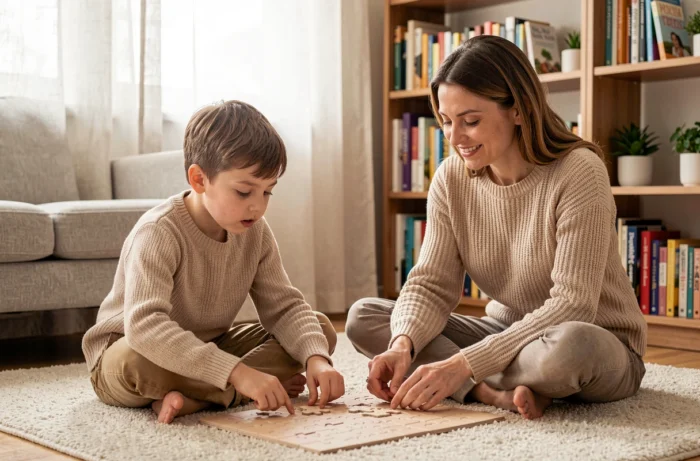
Time spent without screens in silence or boredom does not strengthen anything. The challenge is to plan a minimal activity: reading aloud for younger ones, playing cards, preparing a meal together. Shared activity gives the time slot its reason for existence beyond mere technological deprivation.
Family Communication: Going Beyond Theoretical Active Listening
Most advice on family ties mentions active listening. The concept is known. Its daily implementation poses difficulties that classic guides address little.
Actively listening to a seven-year-old recounting their day requires real cognitive effort after a workday. Recognizing this fatigue rather than denying it allows for format adaptation: five minutes of real attention is better than twenty minutes of distracted presence.
Three concrete tools help structure family exchanges without making them artificial:
- The talking round at dinner, where each member (parents included) has an equivalent time to speak without interruption.
- The discussion corner, a physical place in the house associated with important conversations, signaling to everyone that the moment is serious.
- The mediator of the day, a rotating role assigned to children during minor disagreements, which develops their ability to formulate a compromise.
These tools do not resolve deep conflicts. However, they create a framework where daily tensions find a space for expression before accumulating.

Shared Family Activities: Prioritizing Regularity Over Events
Organizing an exceptional family outing requires energy, budget, and coordination. It’s valuable, but it doesn’t build the relational fabric on a daily basis.
Repeated and modest activities create more shared memories than spectacular one-off events. A weekly walk on the same route, a board game on Wednesday evenings, or preparing Sunday morning meals generate common habits that become, over time, identity markers for the family.
Adapting Activities to Age Without Excluding Anyone
The challenge arises when children are of very different ages. A teenager does not engage in the same activity as a preschooler. Two strategies work:
- Choosing “variable geometry” activities (cooking, gardening, DIY) where everyone has a role suited to their abilities.
- Alternating rituals: one week focused on the interests of the younger ones, the next on those of the older ones, so that each child feels considered.
The rotation prevents boredom and gives each family member the feeling that their preferences matter in the collective organization.
Parent-Child Relationships: What Predictability Changes
Children, regardless of their age, draw emotional security from predictability. Knowing that Tuesday evenings are dedicated to a game, that Sunday mornings start with a leisurely breakfast, or that each evening ends with a shared reading anchors the relationship in a stable framework.
This stability does not require upheaving the family schedule. It requires choosing two or three realistic time slots and sticking to them. The issue is not the quantity of rituals but their persistence over several weeks, then several months.
The available data do not allow for setting a universal minimal threshold for shared time. What recent publications reveal is that the consistency of a modest ritual surpasses the impact of a grand isolated moment. Fifteen protected minutes daily are worth more than an entire day every two months.
Strengthening family ties on a daily basis relies less on inventing new activities than on the ability to sanctify small recurring time slots. Fatigue, screens, and conflicting schedules will not disappear. But a predictable framework, even minimal, gives each family member a space where connection is no longer left to chance.